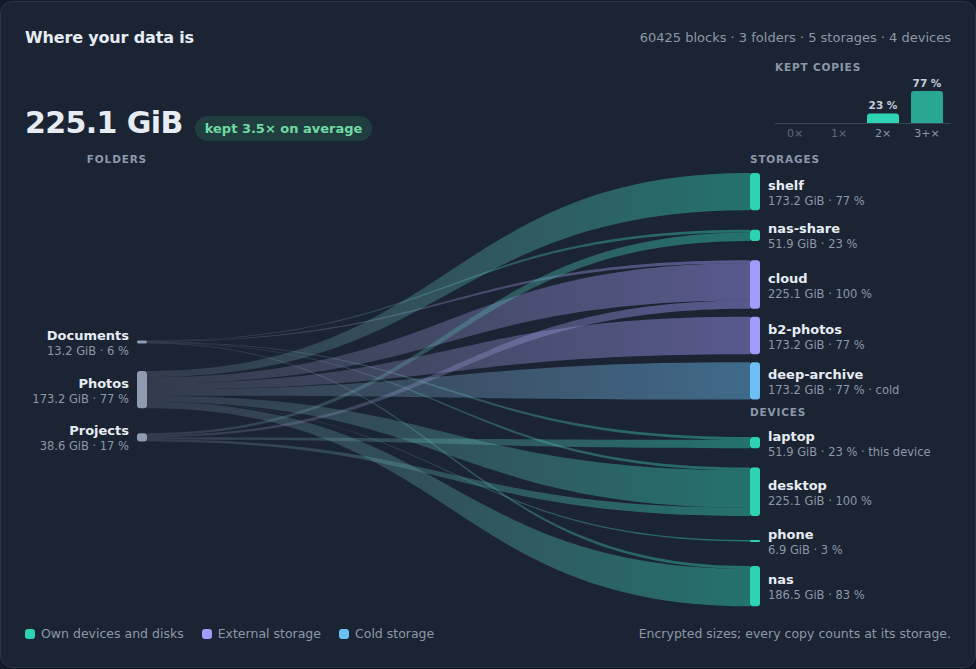
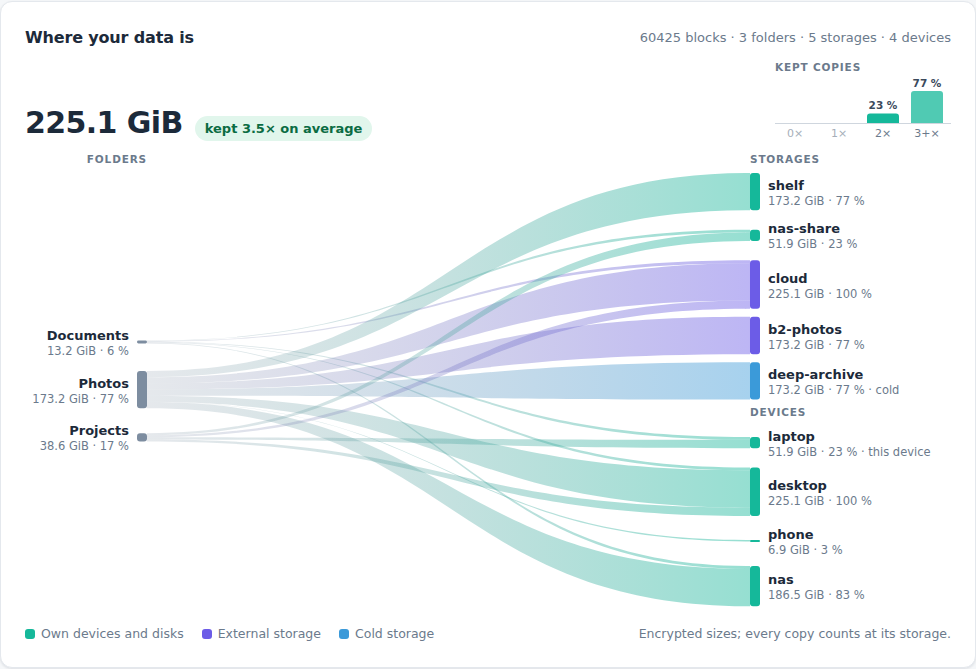
Your files should exist in more than one place. You should be able to see that.
A NAS, a bucket you already pay for, disks in a drawer. Varsto keeps encrypted copies there and tells you when a file has fallen short, before you find out by needing it. No account, and no server that holds the files.
Why you would want it
You want to know a copy is really there
Every device signs what it stored and what it checked. A rule such as “one at home, one elsewhere, checked this month” warns you when it stops being true. Ledger and policies.
You already have the storage
A folder on this machine, a NAS, an S3 bucket, an rclone remote. They see ciphertext and sizes, never names or contents. There is no account to create. Your own storage.
A disk in a drawer should count
Dock a disk, let it fill with whatever has the fewest copies, and eject it when it says it is safe. When it comes back, it still counts as a copy at home. Disk pools.
A lost laptop should not be the end
The keys stay on your devices, and the recovery words stay on paper. Remove a lost device and the others move on. Someone else’s NAS can hold copies it cannot read. Copies that cannot read.
This is an alpha, and neither the design nor the code has been audited. How the encryption works, the threat model, and what changed in this release. The builds are on the downloads page.
Latest from the blog
- Alpha.17: the vault stays, the quiet mistakes go
No new storage format and no new words to write down. Alpha.17 is the release that stops a failed sync from deleting files, keeps the last backup, and tells your phone when something is actually wrong. - Alpha.16: storage format 3, folder access by approval and a rendezvous service
A new storage format with a pack-level ledger, signed records and recovery words, so existing vaults must be recreated; folders are opened to a device by an owner's approval; devices find each other through an optional rendezvous service; joining and membership changes work offline; and imports from torrents and YouTube. - Alpha.15: storage format 2, a Windows installer and a daily channel
A new storage format that fixes two findings of the security review, so existing vaults must be recreated; Windows gets a setup program, a native window and automatic updates; and a signed daily build channel. - Alpha.14: a security review, its fixes, and everything merged since alpha.13
A code-level security review of the whole program, the fixes it asked for, a much faster sync, resumable moves to a stack of removable disks, and the twenty-odd features that had been waiting on the main branch since alpha.13. - Alpha.13: backups that nothing can change
Pick a folder on any device and Varsto keeps encrypted, read-only snapshots of it on your external storages, never on your devices, for as many days as you choose (90 by default). Restores go into a directory you name, from the app or the command line. - Alpha.12: small files in packs, and Varsto in Finnish and Swedish
Small encrypted blocks are now written in packs, so a folder of 20,000 small files becomes 79 objects on a bucket instead of 20,000. The interface, tray, menu bar, mobile shells and this website are available in Finnish and Swedish as well as English. - Alpha.9: data where you want it, repair by itself, signed updates, and every platform built in the open
Folders can be placed on chosen storages and moved between them, lost copies are repaired automatically, updates are signed with an offline key, peer-to-peer downloads fetch many blocks at once, and every package is now built, tested and photographed on GitHub's runners. - Alpha.8: a ledger that stays small, removable devices, and phones that keep nothing in clear text
The ledger now lists only what is new, keeps a cached view and prunes itself behind signed checkpoints; devices can be removed with new keys for everything written afterwards; phones keep encrypted folders as encrypted blocks; and the interface shows where your data is and how peer-to-peer traffic flows. - Alpha.7: pair devices with a code, Finder actions, and a real NAT path
Devices now pair from the interface with a one-time code, Finder can download a placeholder or free up space with a right-click, the macOS app installs from a disk image, devices reach each other through NAT, and removable disks can form a pool. - Alpha.6: the source is public, and every platform builds in the cloud
The repository is now public on GitHub under the PolyForm Shield licence, the native macOS and iOS apps build on GitHub Actions, Linux, Windows and Android build on short-lived cloud machines, and the interface was redone around a file view. - Alpha-0: the first vertical slice
A command-line tool that encrypts, stores and syncs a folder between two devices through storage you own, with a signed ledger you can check.